Thursday, 18 June 2026

#391: Disco Dancing

 I drank almost nothing of great interest (to this blog) during the month of May. An Orval here or there, sure. Sagres from the can in Portugal, grand. Plenty of house Pils of course. One outlier was pulled from under the stairs, but more on that in the next post. 

This lassitude - a hiatus of beery curiosity - continued into June until the appearance of Galway Bay's Disco Paradiso in the local this past weekend. Two cans please, I usually like this sort of thing. Of particular interest was the method of steeping overnight the oats for this mash, presumably removing the cereal on brewday and using this oat milk as part of the liqour for the brew. I am as much an oat milk enjoyer and porridge enthusiast as I am an appreciator of oats in beer, particular a modern hop-forward style like this. Also of interest, on the topic of hops, is the use of Yakima Chief's proprietary Hyperboost hop extract in the dry hop (Strata) as well as a whirlpool addition of Nelson Sauvin.


It's 7.8% and it certainly looks milky, with a small enough cap of foam that, despite the reasonable level of carbonation disappears after 90 seconds, leaving the beer looking slightly ill in its flabby opacity. Not the most beautiful presentation, then. Far more beautiful is the aroma, promising mango and galia melon in spades, overripe and heady and sweet, like sticking the head into a freshly opened bag of hop pellets. This is generally delivered on the palate, but with something else too. The initial intense rush of super sweet mango - ripe almost to the point of tartness - alongside quieter notes of kiwi and grapefruit, is muscled out of the way by a buzz of hot hop dust. These are not the balancing IBUs of a heavily bittered DIPA but (at least to my palate) the sensation is of raw hop pellet. Look, I've been there. When you are around pelletised hops on a daily basis, basking in their aroma, you will be tempted to stick one in your mouth. When you do, you realise that the wonderful fruity complexity of the aroma is nowhere to be found, and in its place is a harsh dusty vegetal bitterness, almost acrid, with pale shadows of the pleasant characteristics barely detectible underneath. 

Of course, this isn't exactly what's going on in the beer; there's plenty to enjoy here but you have to accept that while you're eating your lovely syrupy sweet fruit salad there will be the occasional raw and underripe green pepper, and maybe a twang of garlic for good measure.

You might be forgiven for thinking I hated this beer, but I didn't. I had both cans in succession, clearly feeling there was a high in there worth chasing - the sheer intensity of hop delivery is a decent reflection of what was promised on the can. However, for the price of entry (€6+) I don't anticipate much further exploration. 

After waiting around six weeks to try an interesting beer, one finally comes along that is almost too interesting for its own good.


Wednesday, 22 April 2026

#390: Boredem

I don't know who or what possessed me to pick up a great big bottle of tripel one Friday after work, but I do wish that daemon had exercised a little more better judgement than to guide my hand to Bornem Tripel.

To be fair, it comes Van Steenberge, who bring us sugar bombs like Gulden Draak and old favourite Piraat among many other sweet and boozy pleasures, the best of which are a delight and the worst a cloying mess. So where on this spectrum does Bornem Tripel land? 

Pouring a hazy gold we get a pleasant and enticing nose of sweet honey with just the faintest yeasty prickle. The palate gets a bit more, with a fullsome doughy sweet vanilla marshmallow that almost seems to exand to fill the mouth, such is the effervescence of the beer. There's enough to enjoy there, really. It's simple and sweet, not quite too sweet but just lacking in anything else to liven it up. That doughy vanilla sponge sweetness is desperate for the lemon syrup and herbal flutter that just barely suggests itself, but those points of interest remain ghostly suggestions. A razor thin edge of wheaty prickle lingers in the asftertaste but you need to dig through the sugar to find it.

All told, this is about as plain is a tripel can get. It's far from being a bad beer of course, but one small glass was more than enough. 


Friday, 3 April 2026

#389: Browning

Since the seeming retraction of Newcastle Brown Ale from its position of near ubiquity in Irish offies, the style hasn't tended to be one at the tip - or indeed any section - of the tongue. In recent years, though, brown ales have resurfaced among supermarket own-brand ranges, a welcome and genuinely interesting prospect. There was a time when the pale ale among the red ale, stout, pale ale trifecta of accessible and adventurous brewing was about as exciting as it got. Now we're getting dinky fruit sours, convincing saisons and, today, beautiful brown ales from the own-brand section.


I always have time for Dot Brew thanks to their commitment to leaning into niche styles and, more importantly, brewing them well. There tends to be a perceptible attention to detail and engagement with the style, and that's no different with this here Dot Brew Brown Ale from their current Aldi offering. In the glass it's a mostly clear mahogany with a glimmer of deep red rust, perhaps suggesting a slight murk. The aroma is a very faint dusting of cocoa powder, though to be fair I reckon I've served this colder than any brown ale desires to be. This presents as pleasant milk chocolate and brown sugar on the palate which, while sweet in the main, is not without its light brace of leafy bitterness. It opens up with warmth to a sort of soft cola or mixed berry fruitiness, but in the main it's plain, in a very good way. I could settle into this, and then settle right into another. At 5% it invites a session, a warm and cosy one.

If I had my wits about me I'd gather some other examples from the current micro-revival of accessible brown ales but we'll have to wait and see on that one. For now, take this to be a very lovely beer at a pretty good price, and far more interesting than Aldi probably needed it to be. 

Tuesday, 31 March 2026

#388: Yearning

Poperings Hommel Bier has appeared just once on this blog, and that just won't do. For the past three years or so it has been an essential purchase whenever I happened by Bradleys, the only local merchant I know to stock it. Recently the supply seems to have dried up, apparently the importing of the brand - at least latterly - was a temporary arrangement, which is of course devastating news if that's the case. Years ago it seemed to be a fairly regular presence, sometimes only in 750ml bottles, sometimes even popping up on draught, so hopefully its absense is not permanent. Let this overdue reappraisal not be an elegy.

There's an initial tangle of spice on the nose, a powderfine pepper and stalky celery splashing out of the glass. Dig through this and you find some familiar and enticing caramel. This caramel character is prominent on the palate, with that sweet cosy core wrapped in leaves of grassy, herbal hops. Lemongrass turns to orange marmalade and then to freshly shaven lemon zest, but all tempered by the honeyed and ever so slightly boozy malt core. A wonderful interplay, a joy. As the beer warms you get to appreciate that it is laced with as much yeast-derived character as it is hommel character, or maybe it's the dance of the two that makes it so enjoyable.

As the Poperings pipeline has more or less dried up it's necessary to scratch the itch some other way, and the way I've been doing it is with another of my favourite beers, also scandalously absent from this blog, De Ranke XX Bitter. A pale, hazy orange, it looks more substantial than the Hommel Bier, despite in fact being a comparitively light 6% to the former's 7.5% ABV. Despite a careful pour it's hard to avoid a bit of sediment in suspension, but this doesn't muddy things at all. A beautiful aroma of mixed noble and new-world hop forwardness, although only Brewer's Gold and Hallertau Mittelfrüh are used. It's juicy in a real grapefruit juice sort of way - bitter, waxy and pithy. This bracing rush is softened by a pleasantly grassy and herbal character with another flourish of citrus peel. Superb, moreish. In spite of the well advertised (and dutifully delivered) bitterness, there is a final little dollop of sugar to keep things fun and fairly balanced, even if that sweetness is manifested as a rather bittersweet and satisfying orange marmalade. 

Look, it's a stunner, I'm obviously a fan. While it lacks the rustic quality, dry spicing and yeast forward character of the Hommel Bier, it delivers instead a more robust bitterness with some genuinely juicy hop flavours, and there's still enough herbal estery nonsense to enjoy for the zymurgists among us.


Monday, 9 February 2026

#387: Mescing

At one point in time you might have referred to Mescan as Ireland's resident Belgophiles, but these days I can think of two or three other brewers who might count themselves as such a thing. Still, none other have opted for the stubby Duvel skittle bottles or have pitched themselves as something like a local village abbey brewery, and for that alone Mescan deserve some credit. And so, to celebrate Lá Fhéile Bríde recently it seemed apt to opt for Westport Blond, twelve years after its first appearance on the blog (and since the last mention of Mescan on the blog at all).

Such a plain billing as blond doesn't usually get me excited even when the beer comes from a Low Country but my pleasant surprise with Moinette Blond - along with the fact that so many of the world's most beautiful beers could concievably be called blond ale - leaves me hoping for something fun. What I'm hoping for from a sub-5%-er is a bit of quaffable and quenching yeasty prickle. It's not quite what you get. The spicing here (and of course I'm just referring to the fermentation esters on show) are more wit-like in character; lemon zest and lemongrass abound, with an almost juicy quality thanks to the slightly tart finish. As the beer warms a little there is a simply wonderful and uncanny ripe raspbery aroma that follows through on the palate. If blindfolded and going by the aroma alone, I reckon there's a good chance I might have pegged this for being fruited. There's no sugaryness to the taste though, to the extent where it could actually have used more. As a result it ends up feeling slightly thin and wan, relying on a rush of spirited carbonation, a mild wheaty body and just a hint of lemony tartness to quench the thirst.

And it does quench the thirst. A rainy bank holiday in February is not the worst time for any beer, but this will clearly come into its element in high summer. 
All in all, while slightly plainer than I'd hoped, it more than delivers as a plain Belgian quaffer, with more of a fruity wheaty slant than a dry spicy one. 

Stepping things up is the Red Tripel, which isn't really red but it certainly is a tripel. While lowish on aromatic heft the details are all there - the slightly heady strength, leafy herbals, a sprinking of pepper. The slightly hazy amber doesn't look particularly red but it does suggest some body and this is delivered in the form of honey, marshmallow and warm fermentation sweetness. Over time a touch of banana edges into the aroma and manages to add jollity rather than cloying nonsense. Warm, estery aromatics do develop further over time but never to the extent that you might get from one of the more aromatic tripels or even the (in my opinion) more sweet dominated Westmalle. Ultimately, it's a lovely simple sipper with plenty of cockle-warming credentials and that's more than enough for me. 

Tuesday, 13 January 2026

#386: Decanting

Some Irish miscellany from the Christmas break just past. 

Kinnegar is a producer I always hold in high regard, insterspersing their excellent core range with genuinely interesting and reliably good specials. The latest across my path is this barleywine, snappily named Brewers at Play 48. I was impressed with no.28 in this series, also a barleywine, and this pours a very similar shade of slightly cloudy ruby. An aroma of crabapple, plum and malted biscuit is a total lurer, and immediately dispels any notion that this is going to be big, brash American number (not that there's anything wrong with that). It's moreish and quite balanced, with an air of the rustic about it. I don't know is it the jamminess, the faint estery vibration of it or the sweet, bready cocoa of the finish, but it feels like something you might make at home, and I mean that in a good way. Not the flabbiness of a Yorkshire Singo, but not the razor crystal and lupulin of a Bigfoot either. A wonderful beer.

In the mood for festive soup I popped over to Whiplash for the first time in a while. Down to the Well looks approriately thick and soupy and intially I wonder if I've made a mistake - the opacity gives a greyish sheen to the beer in the glass, not exactly the most appetising of appearances. Quite appetising, however, is the nose of tangy and sharp pithy citrus. This belies the thick and oaty mouthfeel on the palate, which carries another wobble with it - is this a bit trubby, yeasty, muddy? There's absolutely no tickle of yeast bite however, and no acridity whatsoever. It's just supersweet juicy pineapple and grapefruit the beer flashes its IBUs by way of balance. All told it's mostly sharp and juicy stuff and quite enjoyable throughout, and the slightly green edge I feel I detect isn't enough to seriously harm the occasion. 

As a certified NZ enjoyer with a built-in professional interest in New Zealand IPAs, Wicklow Wolf's Still Far Away had to get a spin. It pours a pale and murky yellow and offers weet prickly juice of the tropical sort. Pineapple and mango perhaps, but in a watery way that's quite soft beneath the sharpness of those fruity highlights. In the end I settle on the notion that it's pear syrup that I'm tasting at the core of this, with a sweetness that dries up fairly quickly to leave a slick and easy kiwi breeze. Eminently drinkable and hiding a point of its 6% ABV. 

Lastly, emissaries from Killarney Brewing handed in a few samples to the brewery in happier times, and Christmas in Killarney was the bottle I pulled from under the stairs in that post Christmas fog. Billed simply as a Belgian style ale, this 6.7%er pours like a very convincing dubbel. A tad light in the alcohol, perhaps, but the first impressions are, well, impressive. Sugar and spice additions have been successful here; a gentle waft of warm spice aux Belge and sweet raisiny malt makes for a pleasant and inviting aroma. This is replicated just so on the palate, with plum pudding spiced dark fruit, actual treacle notes and a long if faint rummy finish. It's genuinely impressive how much warming festive heft is crammed into this at such a 'low' ABV, but I guess that's the benefit of judicious additions.

I wish all at Killarney Brewing the best for the future, a sad and rather surprising casualty of the year. 

Tuesday, 6 January 2026

#385: The Debrief

There's no beerier time for me than Christmas, and few times more in need of beer than the cold and grim depths of winter. In the sweet height of summer I will no doubt believe the opposite is true but from this vantage point with those garden beer days a long way away I can only see the succor of big, dark, strong beers pulled dusty and gratefully from under the stairs. 

Truth be told, there was very little interesting drinking happening here this past summer, as we started a double bathroom renovation that has run from May to, well, present day, but with the back finally broken and the long-overdue end in sight, Christmas came and I was determined to get some interesting beer back on the table. Our own (Eight Degrees) pilsner saw heavy use over 2025, and it is by far my most consumed beer of year. It's up there with my favourites too, being a saaz appreciator, but I definitely won't be writing anything in depth about it or any of its stablemates.

And as an aside, many thanks to The Beer Nut for his call out shout out in this year's Golden Pints, and whose encouragement is appreciated and has helped to motivate me into finally bending some of these drafts into posts.

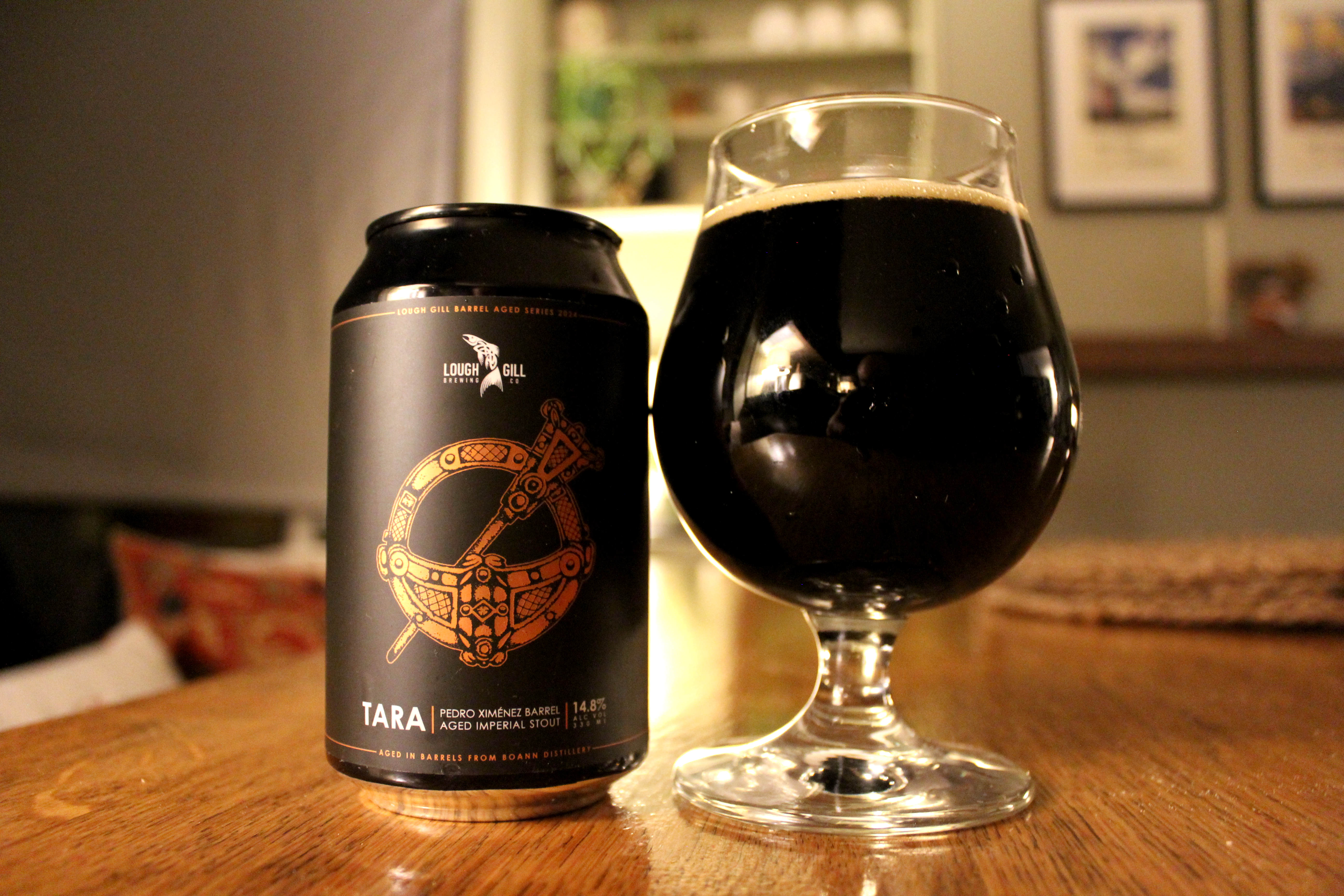
One of my favourite beers of the past year was Lough Gill's wonderful Tara, so when it reappeared for this winter season it was duly squirreled away, along with a couple of its companion pieces. The last fancy beer I had of this past Christmas break was one such companion, the sherry brandy barrel aged Solera. It pours with ink black intensity and flashes just the briefest hint of marker pen booze, but this dissipates very quickly and the aroma opens out to syrupy date, malted milk and treacle. So far, so incredibly enticing. The bones are the same as in the Tara and while the dark fruit characteristics are quite similar, I suppose it must be assumed that the sherry brandy could be contributing some of this, as I seemed to get a lot of Pedro Ximinez-y character from the Tara. There's also a vinous tang and a shade of oxidation to this that the Tara didn't have, and possibly a spirity edge, but this never interferes with the slick and silky dark chocolate and raisin innards. If I had the constitution for such a project I'd like to do side by sides of all the Lough Gill stouts (assuming they are from the same base beer) to parse barrel influences. 

In all, Solera is another stunner, and gives you full value for its 11.9% ABV. This is the time to make hay, this is the time to put some of these away. I don't even know if this will improve with age - there's already more than enough nuance and maturity here - but I know I'll always be happy to pull one out of the stash.

Trinity is the bourbon barrel aged version of Lough Gill's shape shifter and this time the abv reaches a heady 12.9%. Considering this fact it generates a surprising amount of foam atop its oily texture, though dissipating quickly, while unsurprising is the rush of bourbon that greets you. There's no spirity bang though, as vanillin and dark chocolate round out to genuine mocha smoothness. It's lovely and rich and deftly balanced with coffee-bitter and raisin-sweet elements dovetailing beautifully alongside flashes of hazelnut, or even peanut. There's a final flourish of bourbon at the death bringing spirity warmth but not to the detriment of the complex and fruity intricacy of the rest of the beer. Once again, excellent use has been made of the alcohol content and the barrel. Another benchmark for thumping great barrel aged stouts.

All three (including the Tara) of these stouts are well worth the pickup, with the Tara and Solera being more my sort of thing, but only as a matter of personal taste for their quad-like dark fruit expression. The confidence I have in handing over €6 for a can of any of this range is rock solid, and you can't say fairer than that for an endorsement. Long may Lough Gill continue churning these out. 

Wednesday, 28 May 2025

#384: Not Like the Others

 Of Foam and Fury was a bit of a bombshell back in the day - rightfully scooping Beoir's Beer of the Year for 2013 (I think?) with it's proper heft and blast of hops. From my first draught pull I was impressed, but it's been years since I've gone back.

Good timing then for a bit of a revival, albeit modernised and embellished with some Riwaka in celebration of its twelfth year. There's something immediately anachronistic going on here, as Of Foam and Fury Riwaka Edition pours pale and hazy. Another crank of the 'modernise' dial has led to a nose that is sweet and juicy with passion fruit tropicals and a heavy lean toward stone fruit. So far so pleasant, if not entirely in line with the original flavour profile (which, to be fair, is loudly announced on the label of the beer). 

The true novelty and queerness of the beer is apparent on the palate though, where there's an initial wash of what I initially could only describe as butter. No, not diacetyl or any fermentation wonk; it's the strangest thing, a particular creamy sweetness that almost does suggest butterscotch and that is quite at odds with the zestier notes also making themselves known.  This might not sound too promising but arguably even queerer is how the palate quickly adjusts to it, as it turns to a more conventional vanilla. This vanilla along with lime maramalade, tangerine and sparkly sherbert are a sweetish bounty that fill the mouth before calming and rounding down to pineapple and apricot. It's unconventional, it's unexpected, it's delicious. Gone is the crystalline caramel of the old beer - this is almost always the first thing to go with these sort of throuwback beers - but the new hazy vanilla body is not quite the standard NEIPA mode, though it's clearly in that ballpark.

This is nothing like Of Foam and Fury of old, and more importantly - and impressively - it's nothing like most of the more modern/hazy IPAs around at the moment. Mission accomplished.


Friday, 23 May 2025

#383: Bullish

To break the monotony of German or German-inspired beer I've got some actually fresh IPA to chew through from the lovely Bullhouse Brew Co.

First up is the NEIPA Merc Bro, which pours shockingly dark for the style, a shady orange as opposed to the usual pale yellow. The nose is immediately met with sweet strawberry and apricot jam, enticing and genuinely interesting, but the promise of this is not really matched on the palate. Not that it's unpleasant - it's not - but it's also not the cleanest or brightest example of this sort of thing going around. It tastes almost as murky as it looks, a but muddy and indistinct, and is far stickier than the 6.5% ABV would normally suggest. Some of the fruit survives, again in the form of stone fruit and sweet jam, but I was quite glad to move on to the next one.

Which is King Size, a double IPA of 8%. This one is immediately more promising, or at least more conventional for a modern hazy IPA as I expect to find them; it's a good deal paler, even if it is still just as opaque. Again there's oozing sweet juice and again there's sweet strawberry, but this time there's a lot more fun to be had. Heady, fumey pear makes that 8% initially seem closer to 10%, but this is just aromatic bloom. What follows is a suerbly indulgent and enjoyable modern strong IPA, with all the trappings of such; sweet, juicy, tonnes of fruit and a distinct lack of yeast bite. That last bit is in spite of the fact that there are definitely yeast solids in the can, so pour with care. 

King Size is definitely the more successful of the two for me but the Merc Bro could well be doing something for you.


Tuesday, 29 April 2025

#382: Gafflasch

Gaffel Kölsch is a new one on me, and the style is another slightly mystifiying one for me. My only experience of a Kölsch is with the obviously ubiquitous Früh, which I fancy a pleasant pillowy quaffer even if I don't often get around to it. 

At the core of the Gaffel is a nice cereal sweetness, and this core expands almost to fill the whole experience of the beer. With a bit of diligence and optimism you can pull accents of celery, leafy greens and a touch of apple seed, that bitter, woody punctuation. It's almost pilsy and doesn't seem as soft and round as the Früh but at this stage I'm just splitting hairs.

In all, its just simple and pleasant and that's enough. 

To beef up this post and give this stray German a home, here's a quick cameo from Andechser Weissbier Hell, trailing behind his stablemates from the previous post. Unlike a Kölsch, which is a regular enough pickup for me, it's some time since I've had the hankering for a weissbier, but here in the first stirrings of warm weather the fancy has taken me, and when it does, nothing else will do.

Honey, sweet lemon and lemon balm leaves are the immediate impressions and I am impressed. In fact, this is a quite refined weissbier; it's not dry of course, but there's a certain quickness to it, where the sweetness is more aromatic than anything else if that makes sense. No cloying banana or bubblegum here, just an enticingly juicy thirst quencher that, like the Gaffel above, lends itself readily to quaffing, but with far more panache along the way. 

Monday, 7 April 2025

#381: Kloster Buster

All of Klosterbraueri Andechs' beers are new to me, and we start with their helles, which I guess they are calling Andescher Hell. Lo! Melanoidin! Munich malt is presumably the heavy contributor here though the beer is as pale as any other helles, but that intense malted biscuit and light toffee is there, almost suggestive of a darker beer. A great example of what helles should be in contrast to, say, German pils. Bitterness is fairly mild as expected, just a rock solid rounded lager that leans enthusiastically into its Bavarian malt heritage. Dare I say a textbook helles.

Andechs Doppelbock Dunkel pours a clear mahogany, truly a perfect appearance. The aroma is faint enough though, offering only transient whiffs of coppery cola and marzipan. Not the most promising opening for a dark beer of 7.1%, but thankfully its a classic case of under promise, over deliver, because this is rather delicious. Cola dominates again, that softly bittersweet brown sugar and warmly spiced character that is so pleasant in a beer (and indeed a cola). It's also raisiny, but it defies all of these dark and quite rich flavours by remaining quaffable, perhaps dangerously so. This is because the palate is actually quite dry, helping that moreish quality. Which time, it becomes chocolatey, but as the head retention wobbles and fades, you start to notice that the alcohol leaves a tickle of a burn in the throat but, mercifully, not to the sever detriment of the the beer's drinkability. There's even a touch of marker pen in that latent bitterness, another half mark to be docked. 

With the head gone, it feels more like a doppelbock than a dunkel, and the alcohol does begin to show, even in the appearance. Compared to the two doppelbocks featured in my previous post it definitely skirts closer to the excellent Illuminator than the Salvator and does display an impressive level of compexity even accounting for its strength, but it's only fair to say that a few of the rougher edges you naturally encounter when making a big beer like this haven't been fully smoothed out. 

Still, it's a very pleasant affair that I'd be happy to see again, even if it's not going to be the final word in doppelbock.

Andechs Spezial Hell is a festbier of sorts, according to their website. The strength has been dialled up to 5.9% from the core's 4.8% but I don't see what we're getting for that. Ultimately it's another helles. Not as melanoidiny as the above, showing just sweet grain, soft caramel and a wisp of vegetal bitterness. It's very sinkable, enjoyable and forgettable. That's fine, not everything needs to be remembered. Sometimes a beer is just a beer. That being said, we get more from the 4.8% helles than this rather un-festive festbier. 

The standard hell is the pick of the bunch here, but all of these beers are at least worthy of a punt. I look forward to trying any more I come across, extra points granted for beautiful packaging and monkish credentials. 


Friday, 4 April 2025

#380: Seeing Doppel

A couple of years ago I found a pair of Paulaner Salvator mugs in a Mitchelstown charity shop. They date from the 60s or 70s and carry a respectable 25cl each, perfect for splitting a half litre of doppelbock in front of the fire. It's been years since I've had Salvator but when I finally picked one up again, it had been shrunk down to a disappointing but arguably sensible 330ml package. Nevermind sharing then. 

Paulaner Salvator pours mostly clear and paler than I expected, a bright muddy red. Marzipan and milk chocolate ooze from the aroma and follow though to the palate, but there's also a touch of the permanent marker I found off-putting all those years ago. Initially the beer passes by pleasant, though one-dimensional, but after a while the sense of hot booze only grows more prominent. 

Like pretty much every time I've had a Paulaner Salvator it starts fine but tapers eventually towards slight disappointment. It's seemingly more available these days in its new (and admittedly quite nice) packaging, and while maybe not an essential classic it's a compelling enough  purchase at the price and I'm glad to see it knocking around. Still, it has a long way to improve before becoming anything like a go-to pickup for the style. Not that you asked, but that would be Celebrator (for nuance) or Doppel Hirsch (for brute force).

Or it might even be Galway Bay's Illuminator. I've had this a handful of times since release (editorial-repeat purchases are essential, especially in a world of such infinite and ever-changing choice and high competition as beer) and it is easily one of the best doppelbocks I've ever had. By comparison with the Salvator it's a good deal darker, with a red glow emanating from its mahogany tone and offering a beautiful aroma that suggests raisin and concentrated chewy toffee. The palate is stunning, mouth coating without being sticky and giving milk chocolate, toffee, figs and even a hint of that Pedro Ximinez dark fruit concentration that delights me in a strong dark beer. Still, we're only at 7.9% and we are getting serious value for that; it feels bigger. Not boozier, or even stronger at all, just bigger, broader and more long-lived on the palate. 

There's a proper robust bitterness too, that lingers like a wisp of coffee but also cleans up that malt intensity to make it far more drinkable than my tasting notes might be suggesting. Yes, you can quite justifiably sip this fireside as a digestif (and I kind of did, from my wine glass) but you can also grasp a ceramic mug and quaff this (which I definitely did), much like those pious lads depicted on aforementioned mug.

Where the Salvator feels like a good song but with the bass stripped out and the treble all dialled up, Illuminator has the full dynamic range; its rounder, fuller, more complex and far more interesting. Having both of these beers in the same evening was, in hindsight, a terribly unfair exercise for the poor old Salvator. 


Wednesday, 2 April 2025

#379: In the Headlights

Hopfully don't feature regularly enough on this blog, but towards the end of last year and the beginning of this one my craving for modern IPAs brought me regularly to their door. 

Headlights drew me in with its listing of Citra and Nelson Sauvin, both of them worthy of being a headliner on their own, and my first impression is that it's beautiful. Pale and opaque, there's an initial ooze of sweet juice - pineapple, melon and grape combining for a convincingly tropical effect. The palate is fairly sweet, though to be fair the beer is three months old at this stage. In any case it's moreish and delicious, with ripe orange, honeydew melon and some slightly sticky mango syrupy stuff. There's every chance that the bit of age has dulled some of the nuance of the hops in question, especially the somewhat delicate Nelson Sauvin, but I found plenty here to enjoy regardless

As I did in Closet, a DIPA of 7.6%. At only 1.3% stronger than the Headlights, it doesn't quite do enough to make it feel much different. Again it's pale and hazy, again it's sweet and tropical, again we have citrus and pineapple and melon. This time though, sweetness is very much the only thing on show. It's not unpleasant, and I can tolerate this more than a savoury yeast stink or acidic hop burn, but I don't think we're getting the full value of the strength on show. 

For the money and the alcohol involved, Headlights is probably the better bet for bang for your buck, by my barometer. It has all the saisfying mouthfeel you would have wanted from a strong IPA and offers more expressive hop fun. 


Friday, 21 March 2025

#378: Off Season

My son picked this beer out for me, otherwise I probably wouldn't have picked it up. No offence to Bullhouse Brew Co, I just don't get particularly animated about St Patrick's Day and beer tie-ins thereof. It was a good chance though to finally feature Bullhouse on the blog - I recently enjoyed their excellent Saisons In the Sun (no review, check out the Beer Nut's here). The artwork in particular is something I've long admired. Who would look at this and think some horrible AI slop would be better? 

Rolling Patrick pours totally opaque and flashes a promising whiff of sharp citrus and juicy tropicals, enticing and fruity. This reappears on the palate too but only for a flash; thereafter remains a beer that is all texture and very little flavour. To be fair there are shades of dank IPA stuff in here somewhere, but it's not particularly expressive, instead just delivering vanilla, grass and the empty promise of a pillowy body. It's sweeter and stickier than it ought to be at 4.2%, especially while doing not much else.

While we're talking about seasonals, this next one (still appropriately branded for St Patrick's Day) was one I thoroughly enjoyed over Christmas, and I've been unsuccessfully trying to replace it since then. 

The beer is Tara, from Lough Gill's dizzying lineup of archaeologically themed barrel aged series for the winter just past. While big barrel-aged stouts haven't been my bag as much lately as they would have been about five years ago, so I only picked up the one that looked most promising to me, this Pedro Ximinez-aged 13%-er. Expectations are high with that sort of pedigree, and they are immediately met; for as thick and slick and chocolatey as the stout of Tara is at its core, I am delighted by the amount of concentrated raisin and figgy wine. The dried fruit and almond is admittedly a secondary characteristic, the main event being dominated by a thumping great big stout that offers vanilla, dark bitter chocolate and sweet malted milk. It's heady at times, pleasantly and alluringly boozy, but never hot and always moreish. For a beer of  this strength and complexity, that's quite the feat. 

The other beers in the series have made a miraculous reappearance in my local off licence, hopefully the Tara will do the same.


Tuesday, 4 March 2025

#377: Crisp de Burghs

Illness has thwarted by grand designs to take part in the most recent Session, where hosts Boak and Bailey ask What is the best beer you can have at home right now? When able, I'd like to rehash my planned contribution into a sort of post about the house beer situation. Spoiler alert, its liable to be a German lager.

But for now, we settle for reflecttion on the previous week's German lager, the highly regarded Hopburgh Helles from the Alpine idyll of Smithfield, Dublin 7. It pours the colour of golden syrup and despite a fairly lively carbonation the head is loose with big wobbly bubbles that disappear all to quickly. That's about the last wobble of the evening though, because this beer is lovely; big stalky bitterness and, would you believe it, golden syrup on the nose. On the palate there's a suggestion of lemongrass and marshmallow, simultaneously bringing to mind not just native German helles but also Bohemian pils. In this way it's not unlike the Leikeim Pils from a couple of weeks ago, although I would take the Hopburgh over that beer any day. Beautiful, and when it costs more than an Augustiner, it ought to be. 

Not wasting any time we dive straight into the Hopburgh Schwarzbier. I fancy all types of dark lager but this is probably the one I have the loosest grasp on. Like the Helles it pours perfectly clear but in the colour a dark and particularly reddish cola. The foam is slightly more stable on this one too which is a nice bonus. There's a hint of smoke on the nose, rather surprisingly, but this doesn't follow up on the palate, rather unsurprisingly. Instead it's a delightful twirl of raisin and chocolate, with Café Noir biscuit underscoring the finish. Over time the bitterness - always there but rather subtle to begin with - intensifies and combines with the sweeter malts to give a sort of liquorice effect. Beautiful.

Both of these beers are triumphs, and worth the admittedly eyebrow-raising price attached to them.


Tuesday, 25 February 2025

#376: Dieu et Moinette

Surprisingly, this is my first time getting up close and personal with a Moinette despite being a card carrying member of the Dupont fanclub.

Described only as a blond, Moinette Blonde pours much like its more famous little brother the Saison Dupont, pale and highly effervescent with some sediment that demands careful decanting. It also has a touch of the saison's aroma; loads of white pepper and a touch of lemongrass, but the main event even on the nose is a rich and boozy honey and caramel. It's incredibly inviting so I don't dally too long. There's a beautiful malted biscuit on the palate with more of that gentle sprinkling of pepper and some green herbal crunch, maybe a dusting of rosemary? It's subtle enough that note, with yeast coming to the fore mainly as as Dupont white pepper and only moreso as the beer warms up and oxidises, bringing with it some lovely dried and candied fruit notes. 

For all the sweetness - and I must emphasise that this is mainly a sweet affair - the finish winds down to dry almond, making the whole thing delightfully moreish.

There's an argument that this sort of thing isn't the most complex or multi layered beer, something that, at a demanding 8.5%, could be a real bummer. As I see it, its simplicity is its virtue. For an unashamed fan of knuckledragging sugarbooze as well as refined biéres d'art there's plenty here to enjoy, especially with so much of that familiar Dupont yeast character on show. 

Why isn't this called a tripel? I don't know, but the unassuming moniker of Blonde may be a classic case of under-promise, over-deliver. 


Wednesday, 19 February 2025

#375: Leikeim? I Hardly Know 'em!

 I don't know what a landbier is. In fact, a landbier might be nothing at all. A quick click around Google tells us it's simply - predictably - land beer or beer of the land or country beer. Essentially, a marketing name for any beer from a (presumably rural) German brewer that doesn't fit neatly into an established category of its own. As vague as that may be, I'm happy to roll with it. 

Leikeim Landbier tastes every bit a lager, more of a helles than a pils and with a lovely fullsome grain to it. It's not particularly hoppy but it is well balanced, with just a pale suggestion of grass. At 5.4% it's a bit chewy, dare I say even flabby, its full strength not quite delivering much value. A perfectly nice lager then, but the most distinctive thing about this is its landbier 'designation'. 

We're on much firmer ground with Leikeim Pils. This one is a more standard 4.9% and pours a wonderfully crystal pale straw. It's enticingly fresh and grassy, perhaps not as much as Jever (my personal benchmark for a German pils) but after the relative non-event of the Landbier its nice to have more assertive nobles on show. Leikeim are a Franconian outfit and there's something distinctly Franconian to be found in the malt profile here - not the clean grain nothings of the nordsee, nor the pillowy marshmallow of Bohemia, but just as in its geography it is closer to the latter than the former. This gently sweet biscuit wouldn't be out of place in a Helles but it's certainly lighter, paler and cleaner than most of its Bavarian cousins. Malt is fun! The beer is fun too, a perfectly pleasant pils, if not the bitter noble skunk of my heart's desire.

We round out the trio with the Steinbier, a word that exists in my mind mainly as a segment in an episode of Michael Jackson's Beer Hunter TV series. I watched those six episodes to death in the very earliest days of my beer obsession, fascinated by the styles and traditions described but more infatuated with this glimpse of a world, a culture that was (at my time of viewing) already old and changed immeasurably.

Tasting a beer like a Steinbier is exciting for the same reason - here is a living relic, a thing that is done not because it is easy or convenient but because this is how it's done, we like it this way. To my mind, the hot stones added to the mash of a steinbier are supposed to caramelise some malt sugars and impart some wisp of smoke. There's not much of either going on in this one. OK, it is sweet, but not excessively or unusually so. Its mildly raisiny malt and toffeeish stuff is about is distinct as it gets. Like the Landbier, this one doesn't achieve great value for its ABV either, in this case 5.8%. The body is about right, being 'medium' or so, but you'll have had fuller bodies in weaker helles'.

Maybe I'm nitpicking - and missing the point - but this modern drinker was hoping for more novelty from this novel tradition. 

A decent set, but the pils is clearly going to be my pick if I'm ever back among the Leikeims.

Friday, 14 February 2025

#374: Lussssshhh

In the last few years most of my beer buying has been taken up with pils, saison, gueuze, kolsch, pils again or whatever else occupies that queer twilight in the venn diagram intersect of austere and fun. 
But then, every now and again, a homo heidelbergensis such as myself craves the sweet juice of life and nothing will do but a modern soupy IPA. 

The one I've been returning to the most of late is Dot Brew's Lush DIPA. Seemingly first released in mid/late 2024, cans of this still survive in my local and yes, I still buy it and yes, I know it's not fresh and yes, I too waste a massive fucking amount of my life miserably checking the infuriatingly indecipherable 'canned-on' dates of the Northern Hemisphere's canned IPAs but yes, even if you're not sucking the beer straight from the samplecock of a BBT it will still be very nice if it's a very nice beer. 

And Lush is a very nice beer indeed. It's soft and sweet in the main but with a burst of overripe citrus intensity. Crucially it avoids all common DIPA pitfalls; the finish is clean and swift, like a flat Lilt (in a good way). It's definitely sweet but it's definitely not sticky, and even more definitely moreish and approachable. Grapefruit abounds, orange marmalade supports, vanilla recedes, and the body is not as thick and creamy as expected - there's a gentle but essential little sparkle of life in there. 

I don't know how regular Dot keeps their beers, I suspect this might be a one and done situation. And what harm, there are a quintillion iterations of this exact beer to be iterated and all are deserving of their glimmer of life from the immense void of the brewers' subconcious. That said, if you see this one around, it's still got it. 

Tuesday, 11 February 2025

#373: Flussssshh

De Glazen Toren's Saison d'Erpe-Mere is a longtime favourite of mine and I've also been impressed by their wonderful tripel. As such, when I stumbled across a sole, tired Autumn seasonal back in October just days shy of its best before date - a veritable shelf turd of old - languishing sadly beside beers brewed a full two years more recently I decided that bringing him home was the most humane thing to do. 

Cuvée Angelique (brewed 2022) is a slow gusher that creeps ominously up the neck of the bottle once opened but pours quite wonderfully, if carefully decanted. Its appropriately autumnal brown shade is matched by an aroma of raisin. There's suprisingly little yeast on show here, allowing the beer to present basically like a doppelbock. Milk chocolate, more raisin and real warmth appear on the palate, almost enough to suggest an ABV higher than its stated 8.3%. Most surprising of all is the swift dry finish, possibly suggesting diastatic yeast, but producing shocklingly little in terms of an ester profile. 

In all it's very enjoyable but is practically begging for food, ideally some fat sweet salty cheese (I don't know I haven't had real cheese in years. For fellow losers, Koko cheddar block is the one to go for). Whether it has always been this way is anyone's guess, but if and when a fresh version appears on the shelves I'll be very interested to find out.

Tuesday, 4 February 2025

#372: Dead Reckoning

In the earlier days of my beer obsession the appearance of an American craft classic like Left Hand's Wake Up Dead would have been enough to pull me into town for the tick, though to be fair, I'm pretty sure that in those days in the early to mid 2010s it was readily available even here. 
In any case I've never had it and when I spotted it in my local recently it looked quaint and nostalgic and was an immediate pick. 

There is something nostalgic about Wake Up Dead. This is the antithesis of a pastry stout, seemingly hailing from a more innocent time. It is bitter, resplendant with cold coffee, dark chocolate and a hint of fruit. That fruit isn't raisiny like you'd expect but more bitter and tart red berries, although this is very much an undercurrent. The main flavour is dominated entirely by that bitter coffee and chocolate. It is robust and bracing, a true anti-pastry stout, and wonderful for it.