Wednesday, 22 March 2023

#369: Tripel Take

More tripels today. That is, a tripel and a beer I think might be a tripel. Both are relatively later additions to Trappist brewing lineups that are, to put it mildly, well-established, and the latter is where we will start.

The naming of Chimay's Cent Cinquant celebrates the brewery's 150th anniversary way back in 2012, but I have not seen it commonly available until quite recently. It's billed rather vaguely as a strong blonde, though the naming convention does suggest a close connection with its little brother, the undeniable tripel Cinq Cents. 

However, tripel credentials fade soon after pouring. The aroma is fairly mild and sort of sweet, suggesting a bit of honey, but the palate is, well, weird. There's honey here too, but with lemon and thyme streaked throughout, or even herbal lemon balm leaf and mint. It threatens to become medicinal at this point but remains just on the right side of pleasant, easing back into fresh, floral citrus and accomplished Trappist digestibility. 

In the end my assumptions were proven wrong; strong blonde is about the most appropriate name I can think of for this beer, vague as it is, because tripel it ain't. 

Much more of a tripel is Rochefort Tripel Extra - they even put it right in the name. Golden with a light haze, you get all the caramel, cereal and pepper that your tripely heart desires, but the palate is a pleasant surprise. It's bittersweet, potentially leaning more towards the bitter, with genuine leafy hop greens alongside more gentle spice. If that sounds austere, don't worry; all is washed away leaving practially none of that leafiness or spice in the aftertaste, just a streak of honest to goodness caramel malt sweetness and then nothing. 

All this makes for a very pleasant nightcap with perhaps more interest that your usual, sweeter Westmalle or Karmeliet, but both of those beers might be more faithful, contemporary archetypes for the style.


Sunday, 19 March 2023

#368: Roundup!

 I don't often write about beer from Irish brewers, the reason being my employment in the industry as one of those brewers. Over the past few years its been an easy line to take; if I'm not fully willing to talk openly about bad beer (not out of any sense of industry loyalty or protection, but rather a feeling that such would be unprofessional and, given the nature of what makes some beer 'bad', unhelpful and unfair) then am I disingenuous in only presenting the good? 

As a journeyman consumer in the early days of the blog, it was about navigating all that beer had to offer, both good and bad, with the aim of hopefully finding more of the former and avoiding the latter. Although, to the collector, a bad tick might be just as useful and valuable as a good tick. 

While still a collector, I'm no longer bothered about the ticks, just the good ticks. And even then, not at the expense of a good beer. 

When I worked in Bradley's (still the best off-licence in Cork and possibly the country), the trend I noticed was that a new beer is better than an existing beer for many. A customer might show me a beer they picked up last weekend and tell me how it was one of the best they've ever had, before putting it back down and perusing the new arrivals. And why not? With so much quality flowing through the place, imagine how many world-beaters might be sitting undiscovered on the new arrivals shelf. What's better than trying something new? Such is the thrill and for many (including me) the essence of beer as hobby.

Nowadays though, I tend to find myself gravitating towards familiarity. Far from breeding contempt, it breeds contentment. Maybe its a sign of the economic times, that I am far more likely to pick up Saison Dupont, Jever, Augustiner Helles or Geuze Boon for their guaranteed success rate, rather than spend bigger sums on less sure things. 

Or maybe all of the above is but a side issue to the simple fact that I have a particular fondness for Belgian and German brewing styles and opt for those who brew them. Whatever the case, it's fair to say that Irish brewing hasn't featured here for some time, which is not fully representative of my actual buying habits.

Because I almost always pick up new stuff from Galway Bay, one of my favourite brewers in this or any other country. Whether it be convincing examples of continental styles or, I don't know, an opaque DIPA, they do it all and they do it well. 

PDA came out late last year and was a superb example of the latter, brewed with Fuerst Wiacek. All your bright, juicy tropicals in one package with a dusting of sharp lime zest. To taste it's sweeter than expected, with brown sugar and caramel deep in the centre of a ripe, peely marmalade glaze. Syrupy fruit and, at the finish, a flourish of pithy, acid grapefruit make it one of my favourite IPAs of the year. 

Beers That Nobody Asked For is a teeny saison from even earlier in the year, brewed in collaboration with Boundary, standing only 3.8% tall and boasting lemongrass as an ingredient. I'm a sucker for lemongrass at the best of times but a herbal brewing skeptic too, so this could go either way. Unsurprisingly there's a faint, light aroma with light spice and, yes, lemongrass, amongst peppery stuff and an almost off-putting soapy note. Despite being a Dupont worshipper, I tend to believe saisons should be weaker than that beer's 6.5%, but surely not this weak? 

Actually, yes. The brief soapy wobble above is the only suggestion that this beer might benefit from more fullsome padding or a core of Belgian sweetness, because on the palate it's a huge success. Refreshing, spritzy, and super easy to drink, it makes glorious use of a potentially weird ingredient and, given time to develop, brings menthol, eucalyptus and lime cordial in gentle puffs. Why bother writing about this presumably extinct beer? For one, lingering cans of this in the wild might still be well worth the punt (your mileage my vary with the PDA) and, crucially, this is a beer that I Am Actually Asking For. More of this sort of thing, please. 

I don't truly know what a festbier is supposed to be; is it a marzen? A gussied-up helles? Something new entirely? This Festbier from Galway Bay has a slight coppery glimmer to it, landing between traditional helles and modern interpretation of marzen on the EBC scale, with a toffee and noble hop bouquet to match that description. I poured hard, probably degassing the thing but making it nice and slick and moreish in the process, generally offering caramel malts first with a peppering of a lovely floral, perhaps even Teutonically vegetal hop profile.

Whatever a festbier is, this is just a very accomplished lager. 

As is the last of our Galway Bay offerings, Märzen to the Fire. This is simply fantastic and, gladly, is the most current featured here. It has the air of the benchmark of the style with woodsmoke and salty pork up front but none of the weight or savoury angles. On the palate it's every inch a dark lager, with sweet cola and leafy nobles easily glimmering throug the veil of sharp smoke; smoke which acts more like punctuation or colour than roaring into the mouth like the main event, like Schlenkerla's exemplar. To be honest, I could probably drink a lot more of this than of the Schlenkerla in one sitting, which maybe says more about my personal taste and tolerance for ash than about the beers themselves, but there you go. Pick it up.

Staying west but heading north, Kinnegar are another whose newbies attract the eye, and Thumper is no exception. At 7.8% it's about the perfect size for a DIPA, especially, as I am about to discover, one so firmly rooted in the west coast. Yeah, the other one. 

Crystal! Clear bronze, crystal malt and brown sugar are the immediate impression, holding back wafts of pine, orange zest and McVities Jaffa Cake, chocolate and spongey biscuit and all. The sweeter side tempts fate and edges toward overpowering the whole experience but in general it stays the right side of balanced, and lives on as a nostalgic tribute to Sierra Nevada's Torpedo. 

The real draw from Kinnegar though was their Brewers at Play 28 American Barleywine. As a certified Bigfoot fetishist, how will this stack up? 

Pretty well in fact. Orange skins, burnt sugar and apple toffee syrup suggest rich depth with citrussy highlights. To taste its more bittersweet chocolate, plummy fruitiness and a touch of boozy heat. It lacks the Cascadian credentials of my boy out west - there's no blaze of pine and the fruit expressed is more of the dark raisiny sort than the candied citrus and pineapple, but I think the tannic, crystal core has shades of the Bigfoot, albeit with a heavier hand toward the malt.  In any case and aside from my pointless comparison-making, it's a superb, cosy sipper and cans still existing in the wild will come with my recommendation. 

Speaking of things that are superb and cosy, Boundary's Skipper and Orla rounds out the roundup. A Calvados-aged quadrupel of 11.9%, all the ingredients are there for a hot mess. 

Skipper and Orla

Hot mess it ain't. It's typically quad-like of the less degestible, tangibly non-Belgian sort, with dark fruit, rich mince pie or Christmas cake or plum pudding, essentially whatever stewed, concentrated and spiced dark fruit mix you prefer. Then, apple brandy. Genuine barrel character appears, with wood and ripe apple steering proceedings home. That Calvodos character, when expressed through the lens of a quadrupel, makes the beer feel like a completely acid-free Flemish red - all the ripe fruit and leather and woody complexity and apple sauce with none of the sourness.

An unconventional quadrupel, but a triumph of a beer. Any of this sitting around should be snapped up. 

Back to our regular programming next time (probably).

Monday, 6 March 2023

#367: On the Neck

 De Glazen Toren's saison was an instant hit when it came into my life a few years ago and in the intervening period they've continued to impress.

Ondineke is no exception. A tripel of 8.5%, it pours only slightly hazy gold and immediately suggests faint clove and prickly herbs on the nose. There's further wafts of lemon and honey, completing a suitably fresh and estery tripel character. This isn't exactly replicated on the palate; here it's sweeter with honey and lemon drop sweets dominating over the hoppy freshness, now all but smothered. It's moreish and well balanced for all that upfront sweetness with bitter florals keeping it refreshing, and preserving a surprisingly dry finish. 


Another highly accomplished example from Glazen Toren, even if it doesn't reach the heights of the Saison d'Erpe-Mere. 

Tuesday, 14 February 2023

#366: Big Sam

I didn't only have bocks for winter, but this one was something of a culmination of a theme that developed accidentally.

This Samichlaus was bottled in December 2017, and five years seemed about enough time to wait before opening. It may not call itself a doppelbock, but that is more or less how it presents. It's a rather concentrated affair at the best of times and its long repose had only enhanced the intense raisiny port character. Port or sweet sherry is also brought to mind by the notes of vinous oxidation that shimmer in the background, while thick treacly tobacco and caramel make up the main event. For all its 14% ABV its not all that boozy, or at least not unpleasantly so, retaining a sense of digestibility you might expect from one of the better abbey or Trappist brewers. 

So at last concludes the festive wrap-up, the rest of the glasses being filled with pils and pale ales already described here.


Sunday, 1 January 2023

#365: Double Bocked

It's a bit of a surprise, given Weihenstephaner's wide availability on the Irish market, that this year marks the first time I've come across Korbinian, a name I associate with doppelbock about as much as Salvator or Celebrator.

Korbinian lands somewhere between the two. Unsurprisingly it's a melanoidin bonanza, all raisin and toast. Its exceptionaly clean and every ounce a lager, almost to the point of quaffability for a beer of 7.4%. You could nearly go so far as to call it by-the-numbers for a Bavarian dark lager, lacking some of the real heft and concentration of other doppelbocks, but that is to overlook its own wonderful qualities. Still, given the alcohol and price, I'd sooner go for Weihenstephaner's dark lager for a similarly enjoyable experience. 

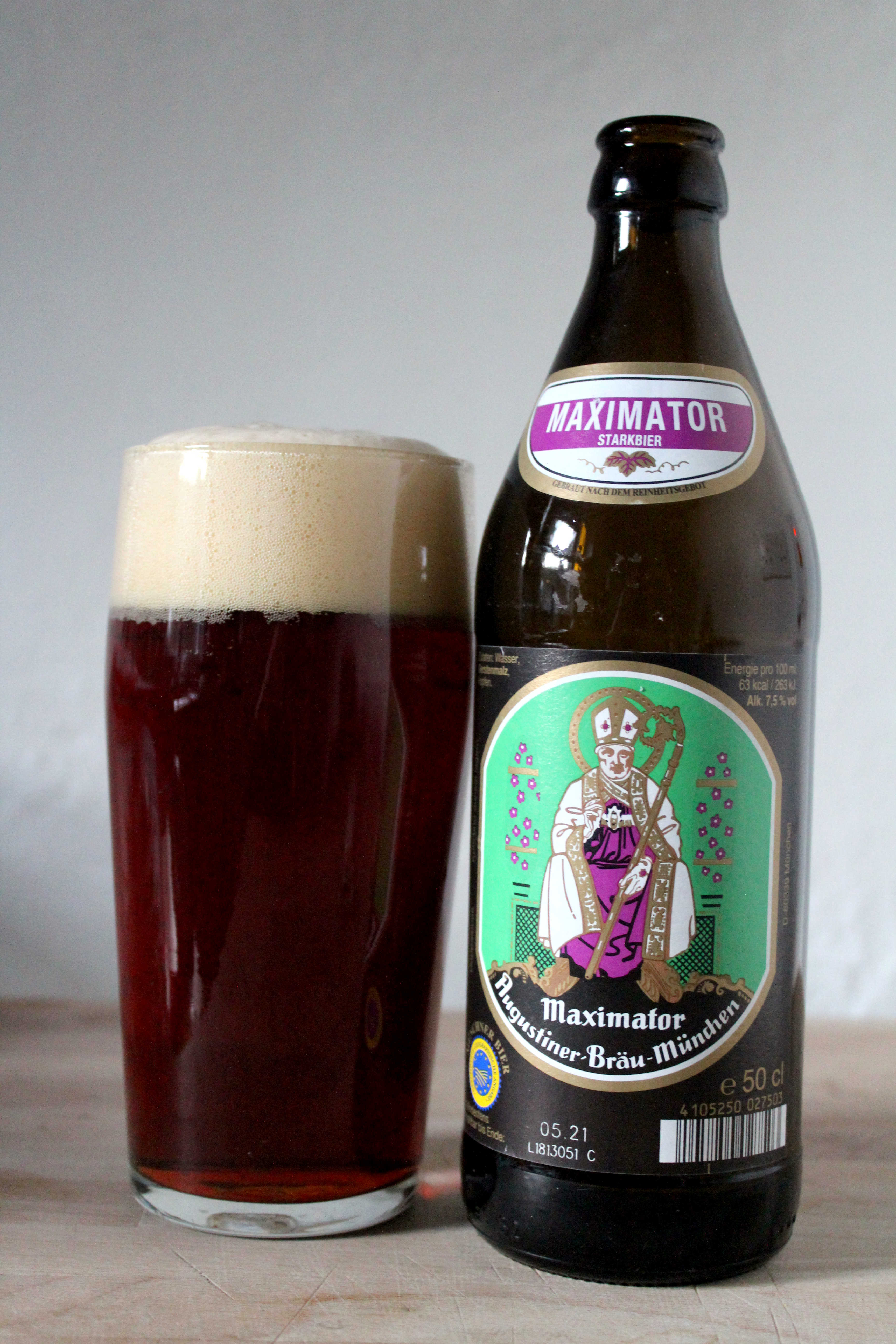
I figured an appropriate comparison for the Korbinian is another of the more elusive doppelbocks from a classic Bavarian brewery; Augustiner Maximator, pulled from the archive.
Many years ago, my parents owned a mahogany furniture set, inherited from a previous generation. When polished, the table was a beautiful chocolate brown with a ruby shine to it, and that is the colour of Maximator, to my mind the perfect hue for a clean, strong dark lager. 
There are no surprises here. A touch of toffee, brown sugar and again some raisin, remaining on the lighter side much like the above, and not drifting in to the boozy, rich and rum-soaked effect you might get in a dubbel or quad. Drinkabilty here is once again off the charts evenn at 7.5%, but that's hardly very surprising given the producers.

Another fine doppelbock, even if it isn't iconic as Augustiner's Helles. Plus, have a look at that label.


Saturday, 24 December 2022

#364: Bock Unsteady

 I don't know quite what it is that distinguishes Ayinger Winter Bock from it's big little equal sibling, the celebrated Celebrator; both are 6.7% ABV, both pour a mahoganey so dark as to almost be black and both promise fulsome comfort for long winter evenings.

The Winter Bock promises 500mls of said comfort, and, while I regrettably don't have both beers in front of me to compare, I immediately detect more roast in here than I remember from the Celebrator. Think whole coffee beans and the slight scorch of black malt, and only a shade of the rich, jammy fruit cornucopia I associate with the Celebrator. 

The beer I did have alongside this one is an old favourite from the same brewery, the Altbairisch Dunkel. It may be a more sessionable 5%, but I can't help but be more seduced by its raisiny, malted biscuit Munich character than by the comparitively heavy and abrasive Winter Bock. That may sound harsh but if all three of the aforementioned beers are on the shelf before you, The Winter Bock might be the last one to reach for, the others doing a similar job to a higher standard. When you factor in the iconic and stunning Celebrator packaging and the multi-seasonal sessionability of the Altbairisch, you'd have to wonder; what is the point of the Winter Bock?

Friday, 7 January 2022

#363: Pulling Ranke

 In celebration of my first full year without a post, here's a post!

I didn't know what it was that puts the noël in De Ranke's Père Noël until I deigned to tread the label halfway through my glass, and by jove it's licorice[sic]! I am no friend of liquorice but have found it a beautiful flavour characteristic in coffee and some (usually) darker, stronger beers, no doubt the phenolic offshoot of some roasting process, but how does it fare as an out and out addition to a pale beer of a moderate 7%?

Quite well, actually. The beer is bone dry and effervescent, with scouring bubbles and an initial gentle touch of tripel-like spice, not unlike an aromatically souped-up Duvel. There's a bracing leafy bitterness that cleans up a rather charming crystal centre, and the lingering, light menthol effect of what I would have guessed was a hop and yeast interplay but may indeed be the liquorice. In any case, it does not taste much like liquorice, but there's plenty of herbal, floral and light spice white noise in here to allow for interpretation.

At 7% it is no table beer, but all of its other characteristics would make Père Noël a fine one; dry and refreshing, moreish, bright and versatile for food pairings, and all the while interesting enough to just drink on its own.